I have always been interested in what happens just beyond the edge of a photograph.
We look at an image and assume that what matters is inside the frame.
A face. A temple. A street in Kathmandu. A mountain.
But when I look back at my photographs of Nepal, I often remember what the photograph cannot show.
I remember what happened before I pressed the shutter.
Who was standing beside me.
How long it had taken to reach that place.
Whether somebody had just made me laugh.
What the air smelled like.
What we ate.
The sounds coming from somewhere outside the frame.
And sometimes I remember what happened afterwards more clearly than the moment I photographed.
The image contains a fraction of a second.
The memory does not.
Looking is not the same as seeing
Photography can make travel appear remarkably simple.
Stand somewhere beautiful. Point the camera. Preserve the moment.
But the photographs that matter most to me rarely work like that.
Often their significance comes from everything surrounding them.
A photograph of a Himalayan landscape may show mountains, but not the hours spent walking towards them. It cannot show tired legs, changing weather, the conversation on the trail or the tea waiting inside a lodge.
A photograph of a Kathmandu street cannot reproduce the horns, voices, bells, footsteps and fragments of music that belonged to it.
It cannot give you the smell of incense or cooking.
And a photograph of a person tells you almost nothing about the relationship between the person behind the camera and the person standing in front of it.
That part of the story is left out of the picture.
Photographing people
This matters particularly when photographing people.
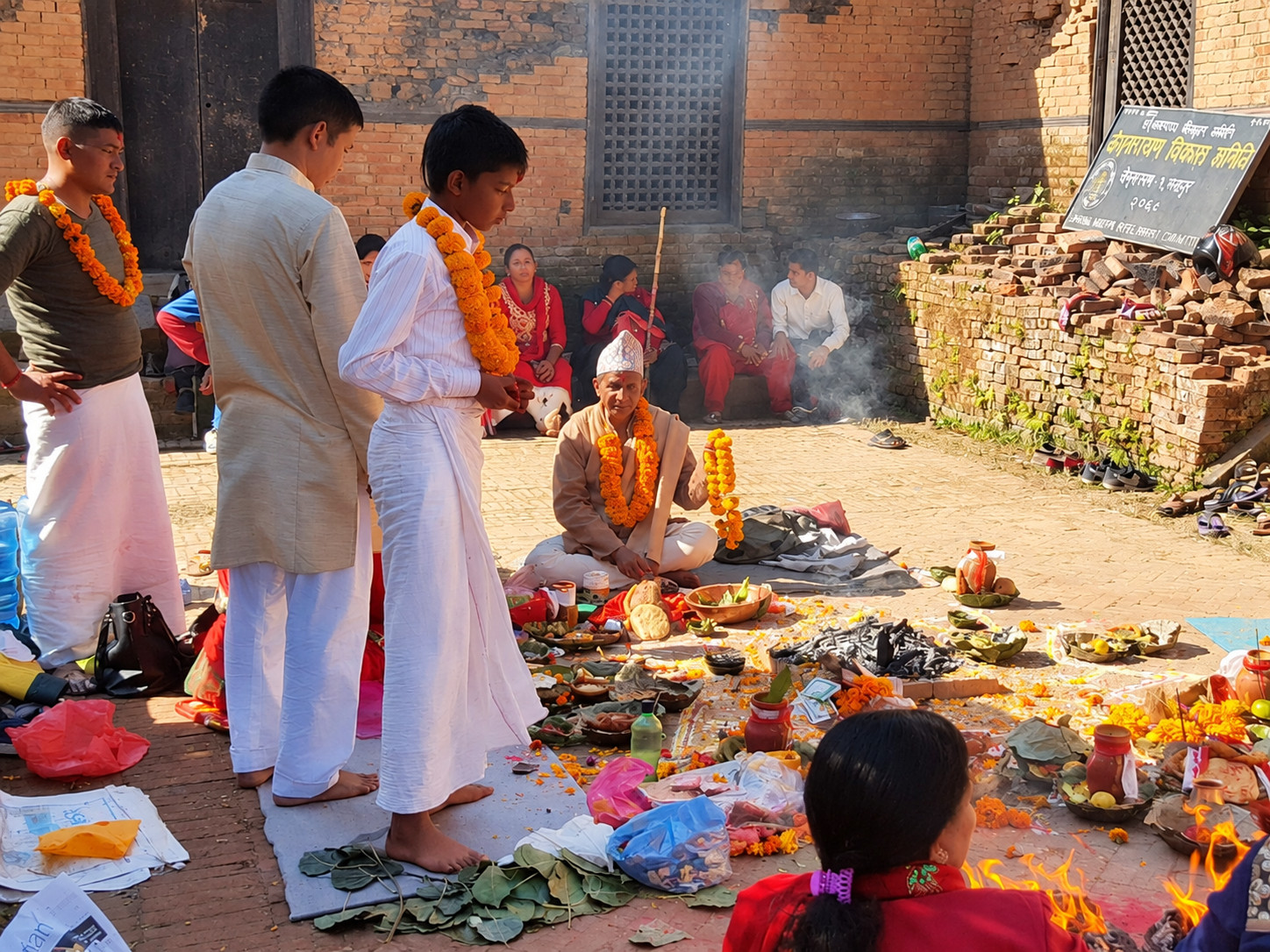
Some of my photographs from Nepal are of people I knew. Others capture ordinary moments encountered while travelling.
Over time, I have become increasingly conscious that a photograph is not simply about what I find visually interesting.
There is another person on the other side of the camera.
That sounds obvious. Yet travel photography has not always behaved as though it were.
People can too easily become part of the scenery of a place: someone in traditional clothing, a child in a street, a person at work.
The resulting photograph may be beautiful.
But beauty is not the whole story.
The question I increasingly ask is not only, What does this photograph show?
It is also: What does it leave out?
Looking back years later
There is another element to it.
Photographs remain fixed, but we do not.
When I look at photographs I took during my first journeys to Nepal, I am not the same person who stood behind the camera.
I know what happened afterwards.
I know which people remained in my life.
I know which apparently insignificant encounters became important.
I didn't know then that Nepal would become somewhere I returned to repeatedly, that I would eventually establish Himalayan Treks, and that years later I would begin writing A Country I Never Left.
The woman taking those photographs knew none of that.
Sometimes I find that moving.
A photograph can preserve a moment while remaining completely ignorant of its future.
What remains outside the image
As I work through old photographs now, I am trying not to use them simply as evidence.
They are prompts.
One photograph can open an entire sequence of memories.
I can remember the road that led there.
A voice.
A meal.
The weather.
A conversation.
Sometimes a photograph brings back something I had not consciously thought about for years.
And sometimes it does the opposite.
I can see exactly where I was and remember almost nothing about the moment itself.
That, too, I find interesting.
Memory has gaps.
Photography has gaps.
Writing has gaps.
They cannot.
But together they can bring us closer.
This is part of what I want the Photography and Journal sections of this website to become: not simply a collection of attractive images from Nepal and elsewhere, but a place to explore what existed around them.
Some photographs will have stories.
Some will have only fragments.
And occasionally there may be a photograph whose most important part is something you cannot see at all.
Something that happened beyond the frame.