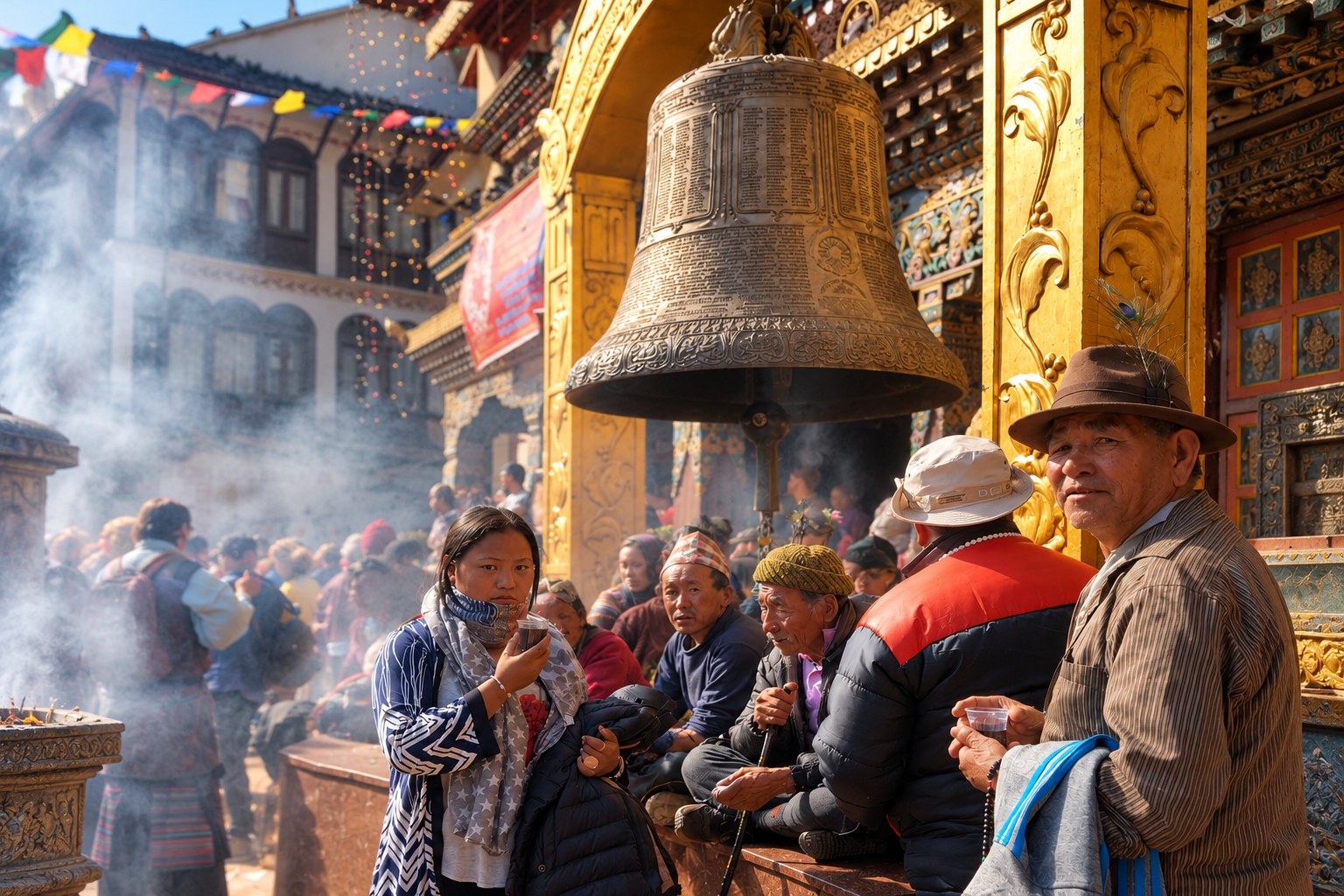
There are places I remember first through an image.
Nepal is not one of them.
When I think of Nepal, before Kathmandu's streets, before the temples, the
prayer flags or the faces of people I came to know, there is a smell.
I noticed it almost as soon as I arrived.
I had stepped off the plane into a country I did not yet know, carrying all the
usual things we bring to a new place: expectations, curiosity, plans and ideas
formed from photographs and other people's descriptions.
But what reached me first was something I had not anticipated.
The air smelled different.
Part of it was incense. But there were other things mixed into it – smoke, the
smell of food cooking, perhaps something earthy that I have never been able to
identify precisely.
It was not any one of those smells, but the particular mixture of them.
It was simply Nepal.
And somehow, over the years, it became one of the strongest ways in which I
remember the country.
Memory does not always begin with a
picture
We tend to speak about travel visually.
We remember streets, landscapes and faces. We take photographs because
photographs seem capable of preserving a place for us.
But memory is less orderly than that.
A smell can bring back a place more quickly than a photograph.
Years after my first journey to Nepal, I could be back in London and encounter
something – incense drifting from a doorway, smoke in cold air, spices from a
kitchen – and for a fraction of a second I would be somewhere else.
Kathmandu.
Not a particular monument or street.
Just Kathmandu.
That suddenness fascinates me. There is no conscious decision to remember.
The distance between London and Nepal seems to disappear.
Perhaps this is one of the reasons Nepal has remained so present in my life. I
did not simply leave it behind when I boarded a plane.
Parts of it travelled back with me.
The Kathmandu I remember
My earliest memories of Kathmandu are full of contrasts.
There was noise and stillness. Traffic and prayer. Dust and flowers. Crowded
streets and quiet interiors. Tea, incense, cooking, traffic, earth.
Morning could begin with small offerings outside homes – rice, fruit and
flowers arranged on leaf dishes – while elsewhere curtains were opening and
the city was beginning another working day.
Temples were not separated from ordinary life.
Neither were religion, family, food and the street.
At first I noticed these things because they were unfamiliar.
Later I noticed them differently.
They had become part of the landscape of my own memory.
The distinction between seeing somewhere and slowly becoming connected to
it lies at the heart of the book I am writing now, A Country I Never Left.
It is not simply a book about travelling through Nepal.
It is about what happens when a place you expected to visit begins to occupy a
much larger part of your life.
What remains after travelling
Photographs are important to me. I have thousands of them.
They allow me to return to details I might otherwise have forgotten: a
doorway, a face, the colour of a wall, the way light fell across a mountain.
But some of my strongest memories have no photograph.
There is no photograph of a smell.
No image can reproduce the sensation of walking into air that suddenly tells
you that you are somewhere else.
Perhaps that is why this particular memory has stayed with me.
I first travelled to Nepal in 2006. At the time, I could not have known how
many times I would return, the friendships I would form, or that Nepal would
eventually become part of both my professional and personal life.
I certainly did not know that, many years later, I would begin writing a book
about it.
Looking back, I am tempted to search those first days for signs of what was
going to happen.
But life rarely announces itself so clearly.
Sometimes the beginning is much smaller.
A plane lands.
A door opens.
You step outside.
And the air smells different.
Years later, on the other side of the world, something catches you
unexpectedly in a London street.
And for an instant, you are back.